Scuttlebutt: harbor news and stories
The Lime Baron’s Harbor
Come into Roche Harbor by boat and the first thing you notice is how finished it all looks — the big marina, the gardens, the grand old hotel above the docks, the cottages in their rows, the little church. It does not look like a factory. It was one. Nearly everything a boater sees at Roche Harbor was built by a single company to make a single product — lime — and the village in front of you is a company town that outlived its company.
The harbor is named for Lieutenant Richard Roche, a British officer who scouted it during the boundary dispute as a site for the Royal Marines’ camp. The Marines cut the first limestone here during the joint-occupation years, and after the islands went to the United States in 1872 a modest works carried on: the Scurr and Ross brothers, two kilns, some 8,000 barrels of lime a year. It might have stayed modest.
In 1884 a Tacoma lawyer named John S. McMillin came to look at the limestone and saw something else — a deposit running three-quarters of a mile along a bluff above deep water. McMillin was an Indiana farm boy who had made himself president of the Tacoma Lime Company, and in 1886 he and his partners bought Roche Harbor and incorporated the Tacoma and Roche Harbor Lime Company. What he built over the following decades was the largest lime quarrying and processing enterprise west of the Mississippi. The works ran on gravity: stone quarried high on the bluff, hauled by rail to chutes, dropped into the kilns, and the finished lime barreled a short distance from the wharf, where the company’s own fleet of ships carried it to growing markets up and down the West Coast.
Around the works he built a town of some 250 people: cottages for the workers, a church, a school, a doctor’s office, a post office, gardens, a farm, and the general store whose descendant, the Company Store, still trades above the marina. First came the Hotel de Haro in 1886, twenty rooms; the McMillins lived in it themselves until 1910. It is still taking guests — the oldest operating hotel in Washington.
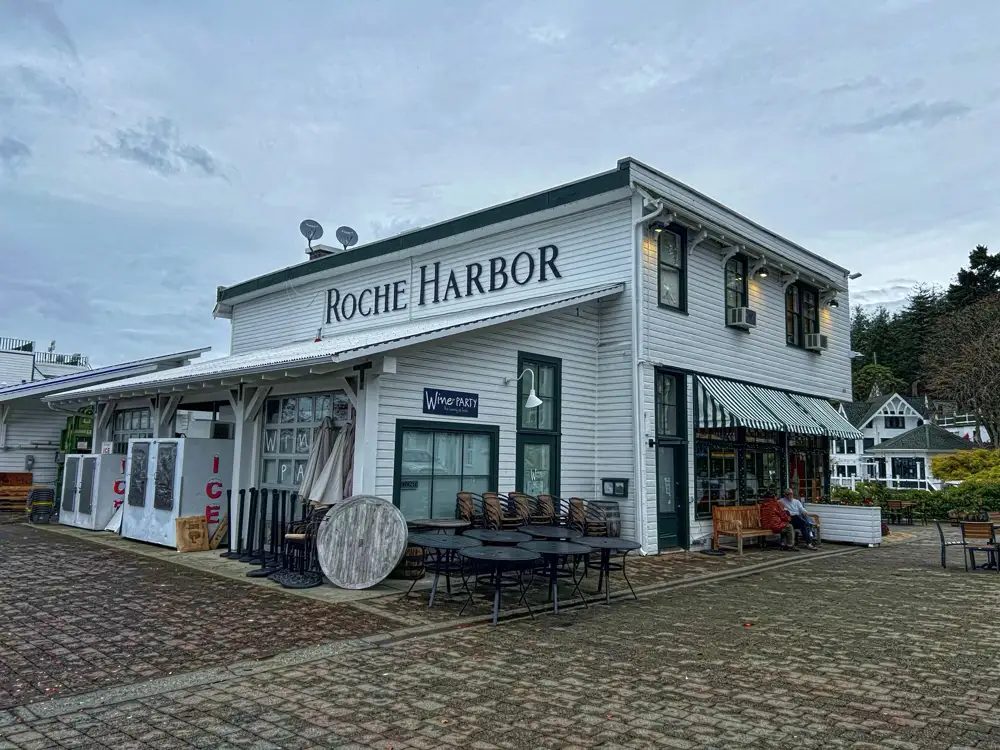
McMillin ruled his town the way nineteenth-century barons did — completely. Stories abound of workers expected to vote Republican, and of men fired when they didn’t. But the baron was also a yachtsman. He founded the Roche Harbor Yacht Club, cruised the islands on his yacht Calcite, and counted among his friends Robert Butchart, the lime man across Haro Strait — whose own worked-out quarry, over on Vancouver Island, became the Butchart Gardens. Two lime barons, two harbors, and two very different monuments to the same stone.
McMillin’s chosen heir was his son Fred, groomed to succeed him; Fred died in 1922, in his early forties. In his last years the old man designed the family’s memorial in the woods above the harbor and named it for the sunsets: Afterglow Vista. It is an open-air rotunda of limestone and cement — a round table ringed by six stone chairs, each holding the ashes of a McMillin, set in the order the family sat at dinner. A seventh place stands empty: its chair was never made, and its column was built broken, to stand for a life’s work left unfinished. The broken column is set so the setting sun shines through it, between the chairs of John and his wife Louella. A bronze dome was planned and never came — his surviving son Paul, faced with the $20,000 it would cost, canceled it. McMillin died in 1936, and the family has gathered at that table, in stone, ever since.
The lime trade faded in the 1930s — demand fell away, and mainland works with newer machinery and cheaper transport took the market. The company held on until 1956, when Paul McMillin sold the whole of Roche Harbor — 4,000 acres and twelve miles of coastline — to the Tarte family of Bellevue. The Tartes saw what the place could become: they restored the Hotel de Haro, put a marina where the lime ships had loaded, laid an airstrip on the old farm, and made a restaurant of the McMillin home. A resort had replaced the works — in the works’ own buildings.
The law caught up with the history in 1977, when the core of the town was placed on the National Register of Historic Places — the kilns, the quarries, the hotel, the cottages, some 140 acres of it. Boaters walk through it all without a ticket: up past the kiln ruins, along the cottage rows, through the gardens to the short trail that climbs through the old cemetery to Afterglow Vista. And on summer evenings the harbor still gathers at the marina for the lowering of the flags, while out over Haro Strait the light does the thing McMillin named his tomb for. The lime is gone. The afterglow is not.
Nordic Tugs: The Little Tug That Invented Its Own Kind of Boat
Walk the docks of almost any harbor in this guide and you will pass one: the upright wheelhouse, the jaunty stack, the hull painted like a workboat that means business. It looks like a tug, but it has never hauled anything heavier than a family's whole summer. It is a Nordic Tug — and it was born about twenty miles inland from the nearest marina in this guide, in the middle of a fuel crisis.
In the 1970s, oil shortages and gas lines had boaters doing hard arithmetic. Jerry Husted, whose Blue Water Boats in Woodinville built ocean-going sailing ketches, believed there was a place for a powerboat that sipped fuel instead of gulping it. Naval architect Lynn Senour agreed, and Husted's flash of inspiration settled the shape: a tugboat. Under the waterline, Senour drew a semi-displacement hull that was efficient at low speed yet able to hurry when asked. Above it, he paid homage to the working tugs of the 1930s — cute and rugged at once, as the company itself puts it.
The first Nordic Tug, a 26-footer, debuted at the Seattle Boat Show in January 1980, priced just under $30,000 and burning about half a gallon of diesel an hour at six and a half knots. The company showed two versions of the boat: Cricket, an open-deck sport model, and Red Apple, the cruising version. Thirty-seven were sold at the show — roughly one every three hours — and 54 by the end of the month. Yachting magazine tried to explain the appeal: "There is something about a tugboat that makes people take to it instantly." By 1982 the Northwest Marine Trade Association was calling Nordic Tugs "one of the biggest success stories of a largely depressed pleasure boat construction scene."
The little tug had not just sold; it had invented a category. Within a year, two rival builders launched pleasure tugs of their own. About half the early Nordic Tugs were sold as honest workboats — "they were considered kind of like a pickup," Husted explained — and the last of them, a 26, went to Pacific Gas & Electric in 1992 to ferry work crews across San Francisco Bay. The cruising line grew instead: a 32 in 1985, then 37- and 42-footers, and eventually boats up to 54 feet. In 1990 the company outgrew Woodinville and moved to Burlington, in the Skagit Valley, where it builds today in an 80,000-square-foot plant, some 1,200 to 1,500 parts going into every boat.
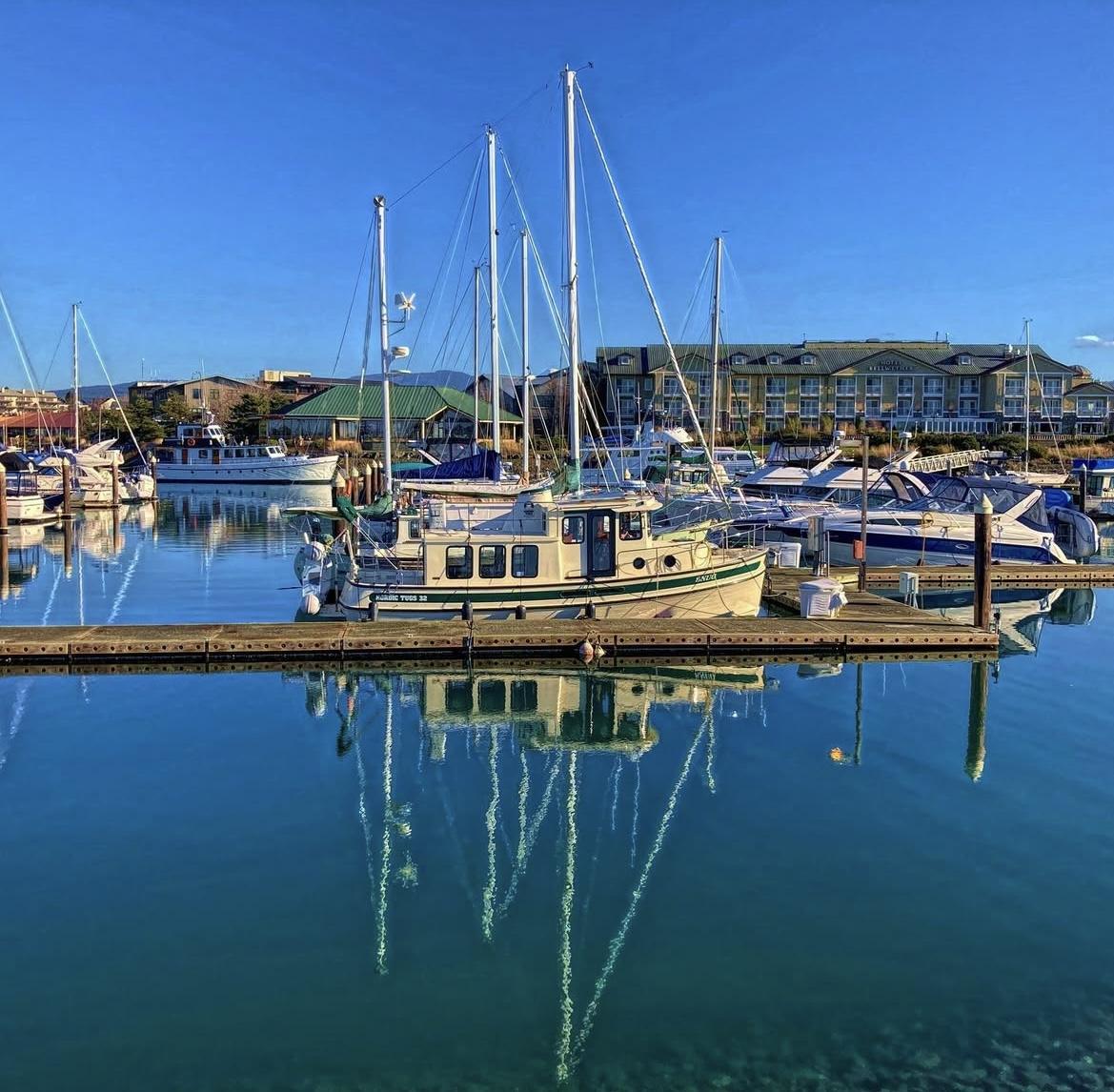
Success was never a straight line. The original 26 was retired in 1997 after more than 170 hulls — then refused to stay retired, keeping a near-cult following until the company relaunched it in 2009. In 2010, in the depths of the Great Recession, the Burlington plant temporarily closed. Nordic Tugs came back from that too. Senour died in 2004; Husted lived to see the whole arc, dying in 2024 at 96.
Owners, meanwhile, turned the boats into a tribe. The Pacific Northwest Nordic Tug owners' association — PaNNTOA — holds a rendezvous every year, filling a host marina with a hundred or more tugs moored together on one dock, a "Nordic Tug Village" complete with seminars, boat-hopping and a poker run. Poulsbo hosted in 2025; Friday Harbor in 2026. Few boats this size have ever inspired that kind of following.
The boats never really left home. They are built in Burlington, sold on the dock at Cap Sante Marina in Anacortes by Seattle Yachts, and moored in harbors all over Puget Sound — the fuel-crisis idea that became the definitive Northwest cruising boat, still wearing a tug's face.
Harry's Beach House: Brunch Where Seattle Began
Alki is where Seattle started. On November 13, 1851, the Denny Party came ashore at Alki Point and named their settlement New York Alki — a monument half a mile west along the shore marks the spot. The beach out front went on to become the first public salt-water bathing beach on the West Coast, and it still runs on the same simple program: volleyball courts, fire pits at sunset, the Olympics across the water, Mt. Baker standing up tall on a clear day. Right across the street from the sand, at 2676 Alki Avenue Southwest, sits Harry's Beach House.
The room has a past of its own. Before the fall of 2019 the space was a Tully's coffee shop, and the fireplace old Alki hands remember from their coffee days still anchors the dining room — one Seattle food guide, praising the place, points to that fireplace as the rainy-day consolation. In good weather nobody is inside anyway: the patio facing the beach has landed Harry's on the city's best-patio lists, and on a fine weekend morning there is a wait for it.
Harry's is the work of chef Julian Hagood, trained at the Culinary Institute of America, who came to Seattle from New York and in 2016 turned a derelict 1910 corner store on Capitol Hill into Harry's Fine Foods. Three years later he brought the act to the water, opening the Beach House with his husband, Jake Santelli. Who Harry himself was, Hagood has never explained — the name came with the first restaurant and simply stayed, which by now feels right for a place the neighborhood has adopted as its own.
The cooking is beach food with a chef's hand on it. The signature is a chowder made the Puget Sound way: geoduck, braised with cream, white wine, lemon and fennel, then puréed into the base — Hagood's own recipe, finished with clams and smoked bacon. The raw bar runs to oysters that change daily, crudo, and a full seafood tower with Dungeness crab. Weekend brunch brings Dungeness crab beignets, cornmeal pancakes with blueberries, and the Harry's breakfast plate; at any hour there are fries with pecorino and frizzled herbs that one Seattle guide flatly calls "legendary spuds," and a chocolate cake with the restaurant's name on it.
The Beach House has settled into beach life the way a good neighbor does: yoga mornings on the sand across the street, drag brunches, and a fifth-anniversary thank-you party for the community in October 2024. Seven years in, it has become what Alki always needed — the beach's own dining room, with the Sound for a window. Open daily: weekdays from 11, weekends from 9 for brunch.
Dirty Dan Harris Steakhouse: A Steakhouse Named for a Smuggler
There cannot be many steakhouses whose patron saint is a ship-deserting smuggler. At 1211 11th Street in Fairhaven, in a brick building that went up in 1890, Dirty Dan Harris Steakhouse has traded on the name of Fairhaven's founder since 1974 — and the founder, it turns out, is a hard act to follow.
Daniel Jefferson Harris was a Long Island boy who shipped out on a whaler as a teenager, deserted his ship in the Pacific, and turned up on Bellingham Bay in 1853 or 1854. Harris was a magnificent storyteller who, as HistoryLink puts it, wasn't above embellishing or making up facts as needed — one reason his own record is so hard to pin down. He settled in a cabin at the mouth of Padden Creek and took over a 146-acre claim that became Fairhaven. The nickname was about appearance, not crime: a well-worn hat, a greasy coat, an unbuttoned red flannel undershirt, pants sometimes held up with rope — and, the kinder accounts add, infrequent bathing.
The crime came anyway. In his early years Harris rowed and then sailed between Bellingham Bay and Victoria, carrying vegetables and smoked salmon over and dry goods, rice, flour and, in HistoryLink's words, lots of alcohol back. HistoryLink is blunt about it: in his first years on the bay, he was a smuggler, and it did not really carry a stigma in those days. The record shows arrests in 1855 for selling liquor to Native people and in 1856 for supposedly inciting the Stikine people against the Lummi — an innocent misunderstanding, one historian concludes. The restaurant's own history page adds the best detail of all: an 1867 arrest involving smuggled liquor in casks labeled "Honolulu Sugar."
He was also the young settlement's master of ceremonies. In 1859 or 1860 he hosted the first recorded prize fight on Bellingham Bay — 104 rounds under London Prize Ring rules before one fighter knocked the other out. March 4, 1885, for Grover Cleveland's inauguration, is still the best-documented day of his life: Harris, an ardent Democrat, raised an 18-by-50-foot flag on a 110-foot pole in front of his hotel, in a production fueled by plenty of liquor and no food, in which drunken Democrats failed to dig the pole hole in the loose sand, a Republican dug it for them, and the flag finally flew less than an hour before sunset.
The money was real. Harris filed Fairhaven's plat on January 2, 1883 — 85 blocks — and shamelessly named the main street Harris Avenue after himself. He sold 238 lots that year, gold coin only, grossing at least $22,000, and spent part of it on a dock and a three-story hotel whose parlor held what was probably the first piano on Bellingham Bay. Legend — and the sources themselves call it legend — says that when he later sold the hotel and the new owner balked at paying extra for that piano, Dan rolled it down Harris Avenue and into the bay. The dates don't quite work. Fairhaven has never let that bother it.
The ending was sadder. Harris married Bertha Wasmer in that hotel parlor in 1885; within a year she had filed for divorce alleging verbal abuse and threats, though the couple reconciled, and in 1888 they moved to Los Angeles, where Bertha died of tuberculosis. There, a doctor who had treated her and his wife befriended the wealthy widower, advised his finances — and, in July 1890, quietly moved a $25,000 bank draft of Harris's into their own account. Harris, by HistoryLink's account, never knew. On August 18, 1890, feeling like a party, he drank, laughed and banged away at his piano, then collapsed and died. His estate, worth about $100,000, was fought over in two states for years; by the restaurant's own telling, his five heirs ended with $33.93 apiece.
The restaurant's home has its own past. The E. M. Day Building went up in 1890, a wooden store built in the boom when everyone expected the Great Northern Railroad terminus to land in Fairhaven — brick came later — and before Dan's name went over the door it was Plutos, a notorious hippie hangout of the late 1960s. The steakhouse arrived in 1974; who first opened it, no published history says, which is somehow in keeping with its namesake. What is documented is the room diners know: wood, brick and brass, an interior once described as designed to resemble a ship, and slow-roasted prime rib in Queen's, King's and Emperor's cuts, with Yorkshire pudding and horseradish cream.
In December 2023 the restaurant nearly followed its namesake into legend. A fire destroyed the 1888 Terminal Building next door — a blaze that took a neighboring café owner's life — and left Dan's building standing but wrecked by smoke and water. The steakhouse stayed closed for nearly two and a half years. Its manager, Steve Marandola, had been planning to buy the place with an investor when the fire intervened; in the end he and Heather Everett bought it together, rebuilt, and on April 7, 2026 simply turned on the sign and opened the doors, unadvertised, so the kitchen wouldn't be overwhelmed. With the Terminal Building gone, the little 1890 building is now the oldest historic building in Fairhaven.
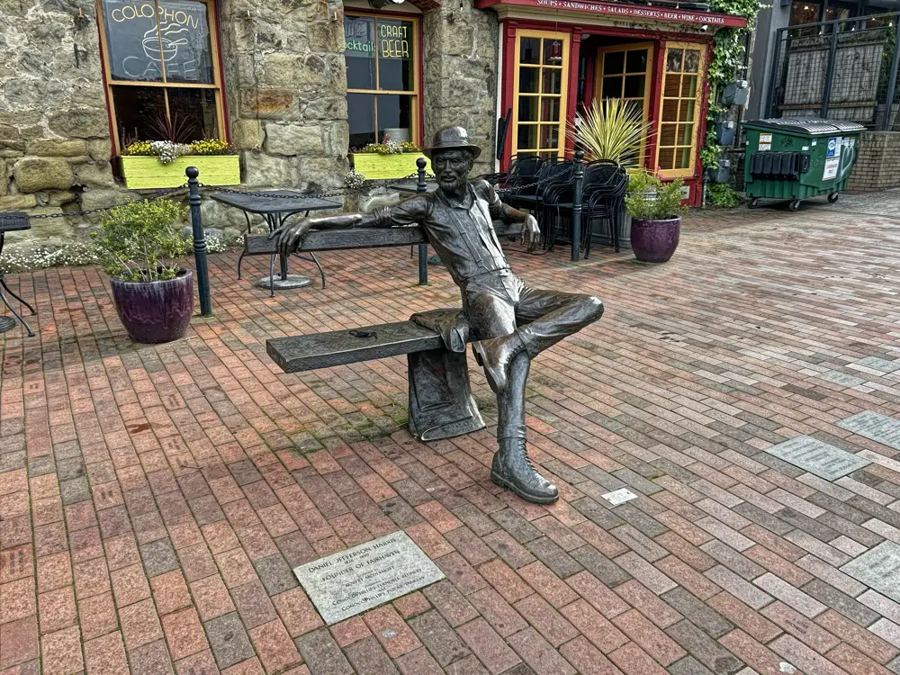
Dan himself still holds court a block away: a bronze Harris, in suspenders and bowler hat, lounges on a bench at the Village Green — a likeness HistoryLink gently notes really isn't much like him. The real one was scruffier, richer, drunker and funnier, and for fifty years his name has hung over the steaks on 11th Street. Fairhaven wouldn't have it any other way.
Dirty Dan Harris Steakhouse, 1211 11th Street, Bellingham — (360) 676-1011.
Fairhaven Station: First Stop in Fairhaven
Every town has a front door. Fairhaven's is a brick building on Harris Avenue where the trains stop — and it has been welcoming travelers to this corner of Bellingham Bay since 1995, when Fairhaven Station opened with Amtrak, buses and cabs under one roof and, from the very first lease, a coffee counter in Suite 215.
The ground itself has been in the welcoming business longer than that. Daniel "Dirty Dan" Harris — a sailor who jumped ship in Victoria and turned up on Bellingham Bay in the 1850s, the nickname earned honestly — platted the town of Fairhaven in 1883 and named its main street Harris Avenue after himself. Fairhaven merged with its neighbors into Bellingham in 1903, and its brick blocks are now a historic district, with Dan himself cast in bronze on a bench at the Village Green. Across the street from the station, the Bellingham Cruise Terminal opened in 1989 on the site of what was once the world's largest salmon cannery, and the Alaska ferry has sailed from there ever since — Ketchikan and points north, over 200,000 passengers a year.
So the station keeps a traveler's rhythm. The Amtrak Cascades rolls in from Seattle and Portland on its way to Vancouver, B.C. — Bellingham is the last stop in the United States, and the northernmost Amtrak station in the country. A few times a day, the building fills and empties like a tide. Once a year the tide is a flood: Ski to Sea finishes down Harris Avenue at Marine Park, the last kayaks coming across the bay to ring the bell. And every April, gumshoes fan out across the district for the Dirty Dan Murder Mystery Weekend, collecting clues shop by shop.
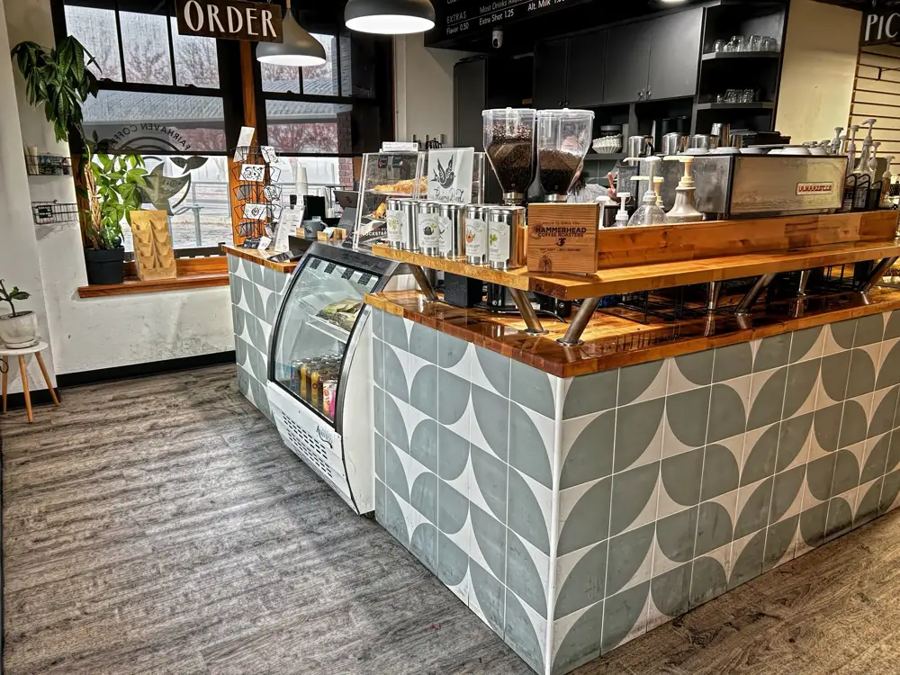
Suite 215 has poured coffee through all of it, under a string of names — it opened in 1995 as Fairhaven Coffee and News, and later ran for years as The Coffee Junction. Its current chapter began in 2019, when Jude and Amber Machin bought a condo in Fairhaven. Amber is a pediatrician whose work brought the couple north — he is from Albuquerque, she is from the East Coast, they met in Texas. Their interior designer happened to own the station's coffee shop, and happened to want to sell. Jude proposed they buy it. They went to barista school, went to Coffee Fest, took over the lease in 2021, and by early 2022 the shop had its first name back: Fairhaven Coffee.
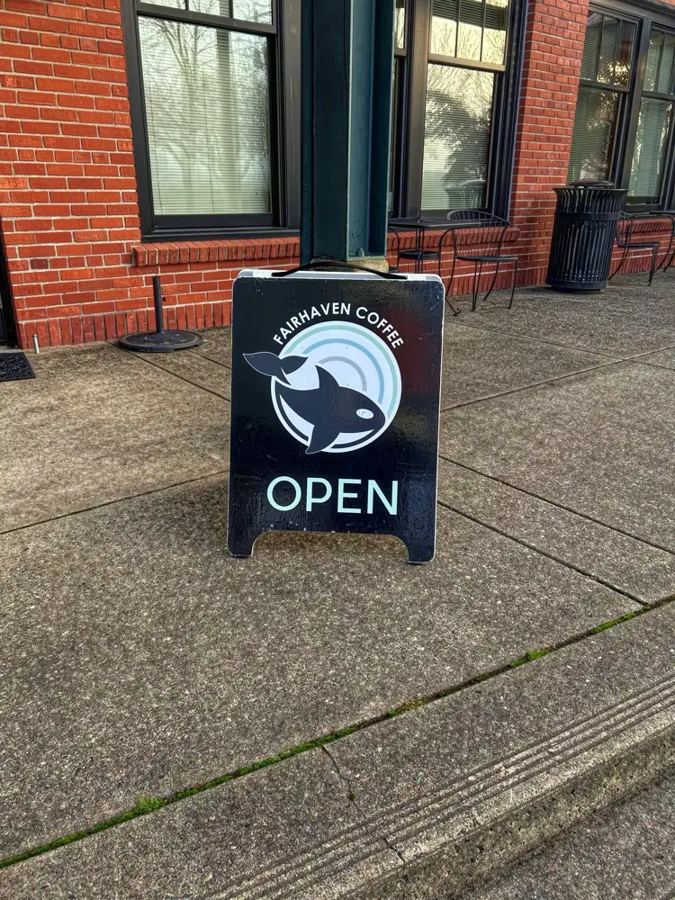
Jude Machin runs it by a local rule: about 90 percent of what is sold in the shop, he says, was made within ten miles of it — the beans come from a Bellingham-area roaster, and there are puzzles and games on the shelf for traveling families with a train to wait for. The work comes in surges: "slammed for 20 minutes three times a day" is how he describes what a train does to the counter. The shop keeps station hours — Wednesday through Sunday, opening at 7:30 in the morning — and it has folded itself into the neighborhood's life, serving as a clue stop for the murder-mystery gumshoes each spring.
A station coffee counter is a small thing, but it is the first taste of Fairhaven most travelers get — before the historic district, before the ferry, before the bay. In Suite 215, that taste happens to come from within ten miles of where you are standing. Dan Harris, who named the street, would have approved of the arrangement.
The Web Locker: Forty Years of Breakfast at the Working End of the Harbor
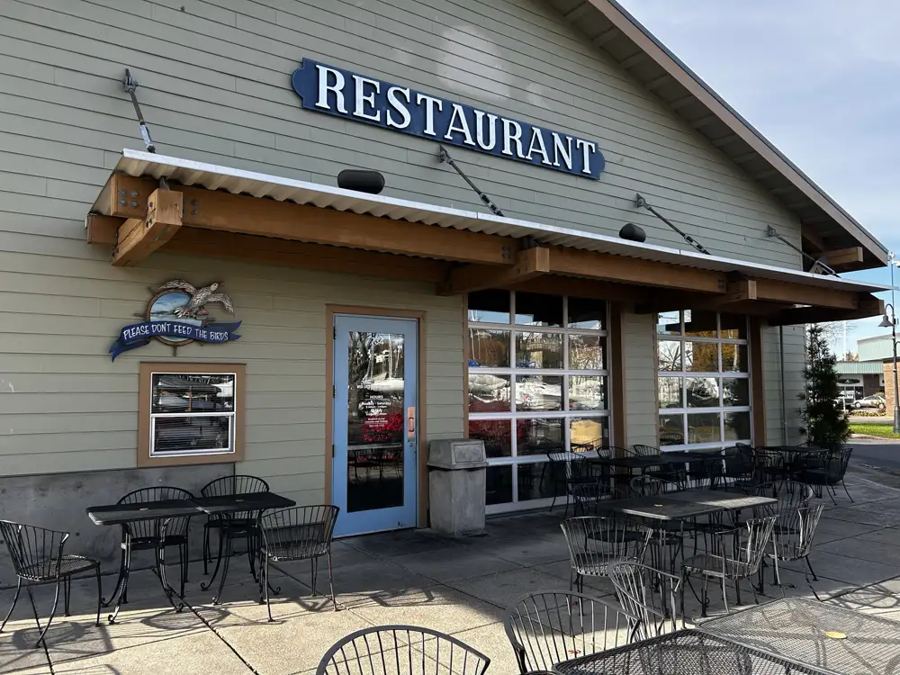
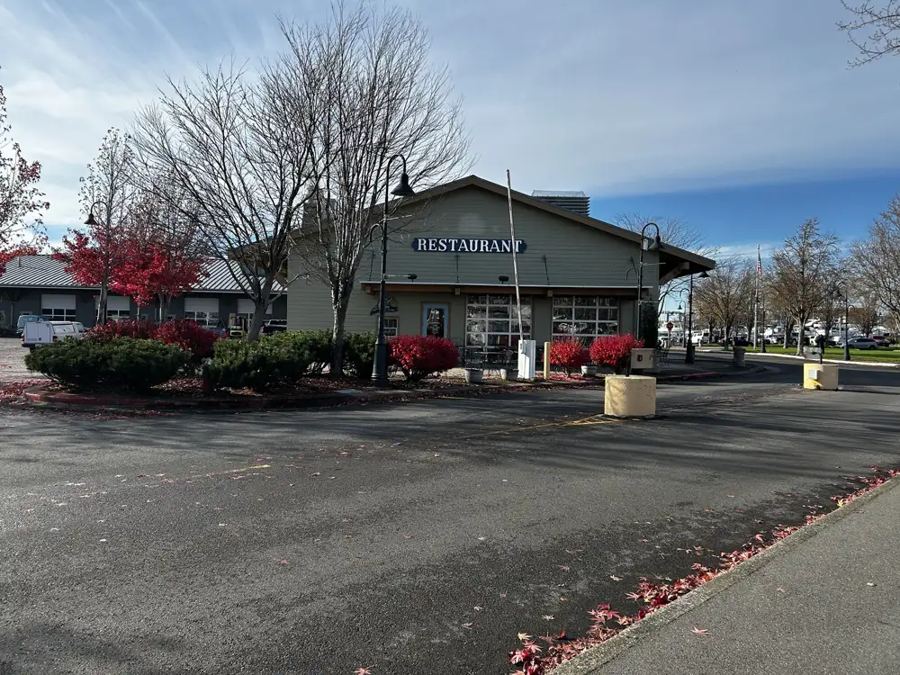
There are two kinds of mornings at Squalicum Harbor in Bellingham. Out on the floats, somebody is always coiling a line, hosing down a deck, or warming an engine. And up at 734 Coho Way, in the little cluster of shops the Port calls Marina Square, the Web Locker is doing what it has done since the winter of 1985: opening at eight, pouring coffee, and feeding the harbor.
If you tie up at Squalicum's guest moorage, it is one of the shortest and most rewarding walks in this guide. Past the masts, up from Gate 3, and you are at the counter.
The name is pure working waterfront, and it is worth explaining, because most visitors walk right past the real thing. A "web" is a fishing net, and a web locker is where a commercial fisherman keeps his gear. Squalicum has been a fishing harbor for a century — the Port built a web house here in the 1920s — and the Port's own inventories still list weblockers and commercial gear storage among the harbor's facilities, a long row of lockers serving the fleet. Whoever named the restaurant in 1985 simply borrowed the sign off the harbor itself.
The harbor around it has never stopped working. Squalicum holds some 1,300 slips, pleasure boats and boathouses on one side, and on the other a genuine commercial fleet — seiners, crab boats and gillnetters, with cold storage and processors across the water. Restaurants have come and gone along this waterfront over forty years, and the lease on the Web Locker has passed through different hands, Captain's Locker among them. The institution outlasted every operator. It never tried to become anything other than what it is: a harbor diner.
Which means the rituals are settled, and regulars will correct you if you get them wrong. You order at the counter. Your cold drink comes out of the refrigerated case. Breakfast runs all morning — the kitchen closes at two — and the lunch trade is built on fish and chips that people cross the harbor for, alongside the Web Classic burger, a cod burger, butterfly shrimp, and chowder. Portions are generous, prices are kind, and nobody is in a hurry to take your table. On a fine day the patio fills, half the harbor seems to be in attendance, and the dog you brought up from the boat is welcome to sit beside you and supervise.
Visiting sailors figured this out long ago. Read the reviews the Web Locker has collected over the years and a pattern emerges: crews who tied up for the night, looked at the galley, looked at each other, and walked up the dock instead. It helps that the place sits in the middle of the harbor's big days, too — on Ski to Sea weekend, the great relay race's kayak leg launches practically from its front yard.
Forty years on, the Web Locker is less a restaurant than a piece of harbor equipment — the front porch of Squalicum. Tie up, walk up, and let somebody else make breakfast.
Web Locker Restaurant, 734 Coho Way, Bellingham — (360) 676-0512. Open daily 8 AM–2 PM, breakfast and lunch.
Downriggers: Rising From the Fire on Friday Harbor’s Front Street
Come into Friday Harbor the way most people do — on the ferry — and Downriggers is part of the welcome. The restaurant sits on the upper level of the Spring Street Landing building at 10 Front Street, just north of the ferry landing, with the whole working harbor spread out below: the marina masts, the whale-watch boats, floatplanes touching down on the water. From the patio in season, or a window table in the main dining room, the view is the meal before the meal.
The name is a piece of fishing gear. A downrigger is the trolling setup salmon fishermen use in these waters: a short boom pays out a steel cable carrying a heavy lead ball, the fishing line is clipped to the weight, and the lure rides at exactly the depth where the fish are. When a salmon strikes, the line pops free and the fight is on. It is how you fish the deep, cold channels of the San Juans — and it is a fair promise of what is on the menu.
Downriggers has specialized in Pacific Northwest food since 1986. Today it is owned by Debbie and Hogan Rishel and runs on local purveyors: oysters, house-smoked salmon, fresh fish. The dish people write home about is the Dungeness Crab Tots — crab and shredded potato with house-made tartar, a plate Eater Seattle singled out in its San Juan Islands dining guide. There is a proper New England–style chowder with the restaurant's name on it, fish and chips in tempura batter with malt vinegar aioli, a crab melt, a salmon Reuben, blackened cod tacos. Groups get the private mezzanine — the best seat in the harbor.
What gives the place its hold on the town, though, is what it survived. In the early morning of August 17, 2013, fire took the old building at 10 Front Street — the restaurant, the marine businesses, all of it. Nobody was hurt, and fire crews crossed from Orcas, Lopez and Anacortes to help. In a thank-you published days later, Debbie Rishel wrote: "Growing up here I have always been aware of our tight Island Community, but going through this makes me realize how much we all support each other."
The Port of Friday Harbor rebuilt the site, seawall and all, and in November 2016 Downriggers reopened in the new Spring Street Landing — the same spot, the same view, a room built for it this time: dining room and mezzanine inside, a patio that opens for the season. The building has since won an architecture award. The restaurant just got back to work.
Forty years on, Downriggers is still what it was in 1986: the place you watch the harbor from, with a plate of the harbor in front of you. Open daily from 11, for lunch and dinner.
Downriggers, 10 Front Street, Friday Harbor — (360) 378-2700. Open daily from 11, lunch and dinner.
The LFS Story
The LFS journey began over 50 years ago in Bellingham, WA. James and Gary Nelson founded LFS, originally known as Lummi Fishing Supplies, to serve the local commercial fishing community. Since its inception, LFS has extended operations to include multiple locations in Alaska and Washington. Over the years, LFS’ expertise has expanded into various industries, including recreational boating & RV, outdoor equipment, and commercial workwear. We believe it is our task and duty to deliver excellence across all divisions of our company and to all our valued stakeholders, including customers, employees, vendors, and the local communities where we exist.
Click the bottom half of the page to flip forward, the top half to flip back. You can also scroll or use the arrow keys.Swipe up to flip forward, down to flip back. Tap a headline on the cover to jump to it.
News from other outlets is summarized in our own words and linked to the original. Sponsored stories come from Dock & Dine advertisers and are always labeled.
Thanks for the scuttlebutt!
We read every tip. If we run it, we'll let you know.